A facilities manager with one building has one set of mechanical problems. A facilities manager with fifty stores has fifty sets of problems, fifty addresses, fifty opening schedules, dozens of rooftop units, a long list of plumbing fixtures, exterior lights, breakers, water heaters, and managers calling from different cities.
The technical repair may still be straightforward. The difficult part is coordinating the work across the portfolio.
At Garrett Mechanical, we built our commercial operation around that problem. We support multi-site facilities across eleven states and work with regional operators, national brands, and facilities-management organizations. We list customers such as PetSmart, Dollar Tree, T-Mobile, and GNC among the commercial clients we serve.
That is a different business from running service calls inside one metro area. Learn more about us and how our commercial model is built.
Vendor sprawl creates work before the technician even arrives
Imagine that each store manager chooses a local HVAC company when the AC fails. Another vendor handles plumbing. A third company takes electrical calls.
Over time, the facilities department ends up managing dozens of contractors with different rates, invoicing systems, response expectations, service notes, and geographic limits.
The repair itself may take two hours. Finding the right vendor, getting approval, confirming coverage, communicating with the store, collecting paperwork, and figuring out what happened last time can take far longer.
Our stated approach is to provide HVAC, plumbing, light electrical, and general facility service across a broad geographic footprint with one commercial service relationship.
For a multi-site operator, that can reduce the administrative side of maintenance even when the individual service calls look very different. A rooftop AC problem in Georgia and a plumbing issue in Virginia do not require identical technicians. They can still move through the same facilities-service structure.
Standard information makes emergency calls faster
Multi-site maintenance gets easier when every location has a usable record: store number, address, operating hours, manager contact, roof access instructions, equipment history, landlord responsibilities where applicable, preferred approval limits, and previous work orders.
Those details should not need to be rediscovered during every emergency.
We work with facilities and vendor-management firms as well as regional multi-site operators and provide rapid dispatch across our territory.
A strong account setup gives the field team useful information before the technician reaches the property. That is especially important for a national or regional chain where the person approving the service call may work hundreds of miles from the actual location.
The store manager can explain what is happening in the building. The facilities team should already have the account rules.
Preventive maintenance becomes more valuable when the portfolio gets larger
One neglected rooftop unit is one problem. Twenty locations with no consistent maintenance schedule can become a pattern.
We provide commercial HVAC preventive maintenance along with emergency repairs, diagnostics, rooftop-unit service, split-system work, and equipment replacement.
For multi-site operators, the practical benefit of preventive service is not just inspecting equipment. It is creating some consistency across properties.
Which units were serviced? Which equipment has recurring issues? Which sites are likely to need replacement planning? Where has a repair recommendation been deferred?
A regional facilities director can use that information much more effectively when it arrives through a consistent service process rather than fifty unrelated contractor invoices.
The same thinking applies to general facility inspections and recurring maintenance outside HVAC. We also offer plumbing, light electrical, and general maintenance, which gives the account another way to identify repeat problems across multiple sites.
A multi-state provider still needs local field coverage
A national phone number by itself does not repair equipment. Somebody still has to reach the store.
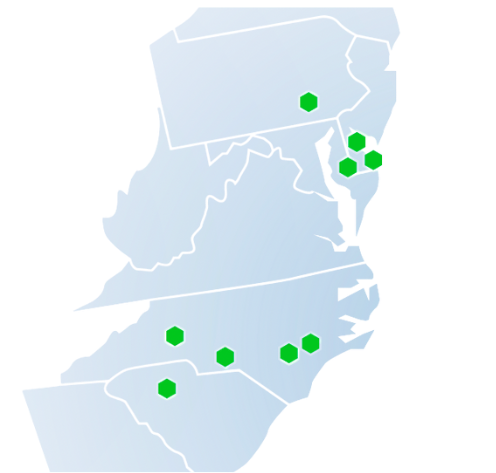
We describe our model as having technicians positioned across our service territory and scaling coverage and technician capacity around client portfolios. We currently list service in Alabama, Florida, Georgia, Kentucky, Maryland, Mississippi, North Carolina, South Carolina, Tennessee, Virginia, and West Virginia. See the full coverage map before you consolidate work.
For a facilities team, this is where coverage maps matter. A provider may be excellent in one state and have no meaningful presence in another. Before consolidating work, compare the vendor's actual footprint against the portfolio.
The goal is not to have one phone number at all costs. It is to have a service structure that reaches the places where we actually operate.
Portfolio service works best when the escalation rules are clear
Not every work order deserves the same response. A failed rooftop unit in an occupied retail location during business hours may be urgent. One exterior light out in a large parking area is another type of call. A slow fixture repair in an employee restroom may fit into normal scheduling.
The facilities department should establish how those calls are categorized and who can approve what level of work.
We provide preventive, urgent, and emergency commercial service and state that 24/7 emergency response is available for contracted partners through emergency response.
That contracted relationship becomes more useful when both sides know what qualifies for immediate dispatch and what can be placed on a normal schedule. Otherwise, everything becomes an emergency simply because a store manager wants it handled quickly.
The goal is fewer handoffs, not fewer specialists
A multi-trade provider does not mean one technician repairs every possible system. Commercial HVAC, plumbing, and electrical work still require the appropriate skills. The advantage is on the coordination side.
The facilities team has one service relationship that can route the work to the right field resource rather than asking the manager at each store to build a new vendor list every time something changes.
Our own site describes this as direct accountability without handoffs and highlights multi-trade coverage as part of our general maintenance operation.
For an operator responsible for dozens or hundreds of locations, that can be just as important as the repair itself.
We provide commercial HVAC, plumbing, light electrical, and general facility service across the Southeast and Mid-Atlantic. Facilities teams can contact us at (904) 822-3339 or hello@garrett-mechanical.com to discuss portfolio coverage, or submit a service request online.